Mr. Earnshaw's Death
Wuthering HeightsMr. Earnshaw's Death marks the end of the founding generation at Wuthering Heights and the beginning of the novel's long spiral into ruin. The elder Earnshaw, who had brought the orphan Heathcliff home from Liverpool and raised him as his own, dies quietly in his chair one October evening, seated by the fireside. His passing removes the sole figure whose authority had held the household's rivalries in check, and it immediately exposes Heathcliff to the unchecked hostility of Hindley Earnshaw, the returned heir. The event is narrated by Ellen Dean, who was present in the room, and it stands as the first great rupture in the domestic order that the rest of the novel's violence and revenge will trace back to.
The Death Scene and Its Witnesses
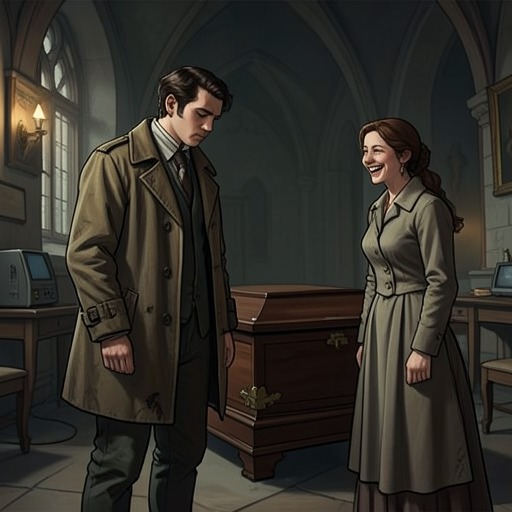
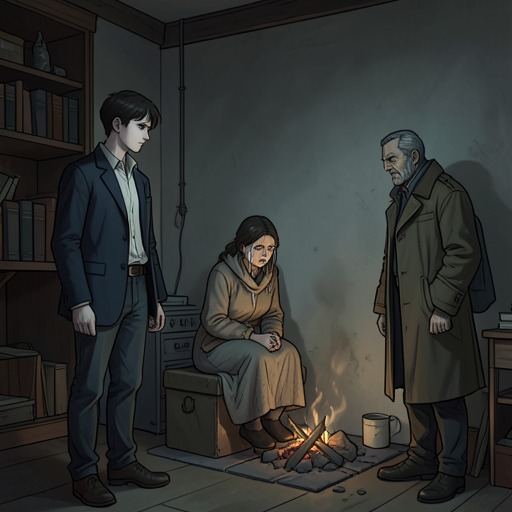
The death occurs on an October evening marked by a high wind that blustered round the house and roared in the chimney, sounding wild and stormy yet not cold. The household was gathered together in a rare moment of stillness: Ellen Dean sat a little removed from the hearth, busy at her knitting, while Joseph read his Bible near the table, for the servants generally sat in the house then after their work was done. Miss Cathy had been sick, and that made her still; she leant against her father's knee, and Heathcliff was lying on the floor with his head in her lap. The master, before he fell into a doze, stroked her bonny hair, pleased rarely to see her gentle, and asked, 'Why canst thou not always be a good lass, Cathy?' She turned her face up to his, laughed, and answered, 'Why cannot you always be a good man, father?' When she saw him vexed again, she kissed his hand and said she would sing him to sleep. She began singing very low, until his fingers dropped from hers and his head sank on his breast. Ellen told her to hush and not stir, for fear she should wake him. They all kept as mute as mice a full half-hour, and would have done so longer, only Joseph, having finished his chapter, got up and said that he must rouse the master for prayers and bed. He stepped forward, called him by name, and touched his shoulder, but he would not move; so he took the candle and looked at him. Ellen thought there was something wrong as he set down the light, and seizing the children each by an arm, whispered them to frame up-stairs and make little din, for he had summut to do.
The Children's Discovery of Loss
Catherine, before anyone could hinder her, put her arms round her father's neck to bid him good-night, and the poor thing discovered her loss directly. She screamed out, 'Oh, he's dead, Heathcliff! he's dead!' and they both set up a heart-breaking cry. Ellen joined her wail to theirs, loud and bitter, but Joseph asked what they could be thinking of to roar in that way over a saint in heaven. He told Ellen to put on her cloak and run to Gimmerton for the doctor and the parson, though she could not guess the use that either would be of then. She went through wind and rain and brought the doctor back with her; the parson said he would come in the morning. Leaving Joseph to explain matters, she ran to the children's room, where their door was ajar and she saw they had never lain down, though it was past midnight. They were calmer and did not need her to console them; the little souls were comforting each other with better thoughts than she could have hit on. No parson in the world ever pictured heaven so beautifully as they did in their innocent talk, and while she sobbed and listened, she could not help wishing they were all there safe together.
The Immediate Aftermath and Hindley's Return
Mr. Hindley came home to the funeral, and a thing that amazed the household and set the neighbours gossiping right and left: he brought a wife with him. What she was, and where she was born, he never informed them; probably she had neither money nor name to recommend her, or he would scarcely have kept the union from his father. The return of Hindley with Frances marks the beginning of Heathcliff's degradation, as the new master of Wuthering Heights immediately sets about reducing the foundling to the status of a servant. The death of the elder Earnshaw thus does not merely end a life; it transfers the property and authority of Wuthering Heights into the hands of a man whose resentment of Heathcliff had been cultivated since childhood, and who now had the legal power to act on it.
The Economic and Narrative Consequences
The consequences of Mr. Earnshaw's death ripple outward through the entire economic structure of the novel. Years later, Heathcliff, having returned with wealth, proves to the attorney that Earnshaw had mortgaged every yard of land he owned for cash to supply his mania for gaming, and that Heathcliff himself was the mortgagee. In that manner Hareton, who should now be the first gentleman in the neighbourhood, was reduced to a state of complete dependence on his father's inveterate enemy, living in his own house as a servant, deprived of the advantage of wages, quite unable to right himself because of his friendlessness and his ignorance that he has been wronged. The elder Earnshaw's death thus sets in motion a chain of inheritance and dispossession that culminates in Heathcliff's usurpation of Wuthering Heights, the very house where the dying man had once sheltered him. The old man's quiet death, mourned by two children who had no idea of the catastrophe awaiting them, is the seed from which the novel's entire structure of revenge, property struggle, and generational ruin grows.
The Death's Place in the Novel's Gothic Architecture
The death scene also establishes the novel's characteristic fusion of domestic intimacy and Gothic foreboding. The high wind roaring in the chimney, the children's innocent talk of heaven, and the sudden discovery of death in a chair all prefigure the novel's later hauntings. The elder Earnshaw's death is the first of many in the novel, and it sets the pattern for how death will be handled: the quiet passing, the grieving children, the intrusion of Joseph's religious severity, and the long-term economic consequences that no one at the moment can foresee. The scene's power lies in its restraint, the way a single evening of domestic peace dissolves into the beginning of a decades-long tragedy, and in the way the children's mutual comfort, with Heathcliff's head in Catherine's lap, already foreshadows the bond that will define and destroy them both.